
Solves Fundamental Dyeing Quality Issues:
Our dyeing fixing agent addresses the inherent weak fastness of reactive and direct dyes, particularly wet fastness properties. These dye classes, while offering bright, clear shades and good lightfastness, often show poor resistance to washing, water, and perspiration. Unfixed dye molecules remain on fibers, causing color bleeding that stains white areas during washing and reduces color intensity over time. This results in customer dissatisfaction, returns, and failed quality inspections. Our fixing agent creates additional chemical bonds that lock dyes permanently to fibers, dramatically improving wet fastness while maintaining the positive characteristics of these dye classes.
Ideal Applications:
Cotton reactive dyeing fixation
Direct dye fixation on cellulosic fibers
Quality improvement for export fabrics
Dark shade fastness enhancement
Home textile dyeing (requiring frequent washing)
Garment dyeing post-treatment
Meeting international fastness standards (ISO, AATCC)
Organic cotton dyeing (using approved fixers)
What Makes Our Product Stand Out:
Our fixing agent uses advanced cationic polymer technology specifically optimized for cellulosic fibers. The molecular structure features multiple cationic sites that bind strongly with anionic dyes, plus reactive functional groups that can cross-link with cellulose hydroxyl groups. This dual-binding mechanism creates a permanent dye-fiber-fixer complex. Importantly, our formulation is designed for minimal shade change – most competing products darken shades or cause dulling, but ours maintains color purity. The low molecular weight ensures good penetration while avoiding surface deposition that could affect hand feel.
Why Choose Us Over Competitors:
Improves wet fastness by 1.5-2 grades consistently
Minimal shade change (<0.5 grade="">
Does not affect fabric softness or drape
Effective at economical dosage (1-3% o.w.f.)
Compatible with softeners (can be applied together)
Works across wide pH range (4.0-6.0)
Suitable for both reactive and direct dyes
Does not reduce lightfastness
Passes environmental and safety standards
Easy integration into existing processes
Reduces re-dyeing rates and waste
Key Performance Features:
Excellent wet fastness improvement
Suitable for reactive and direct dyes
Minimal shade change or dulling
Does not affect fabric handle
Compatible with softening agents
Easy application methods
Cost-effective dosage
Environmentally acceptable
Meets safety standards for textiles
What is Dyeing Fixing Agent?
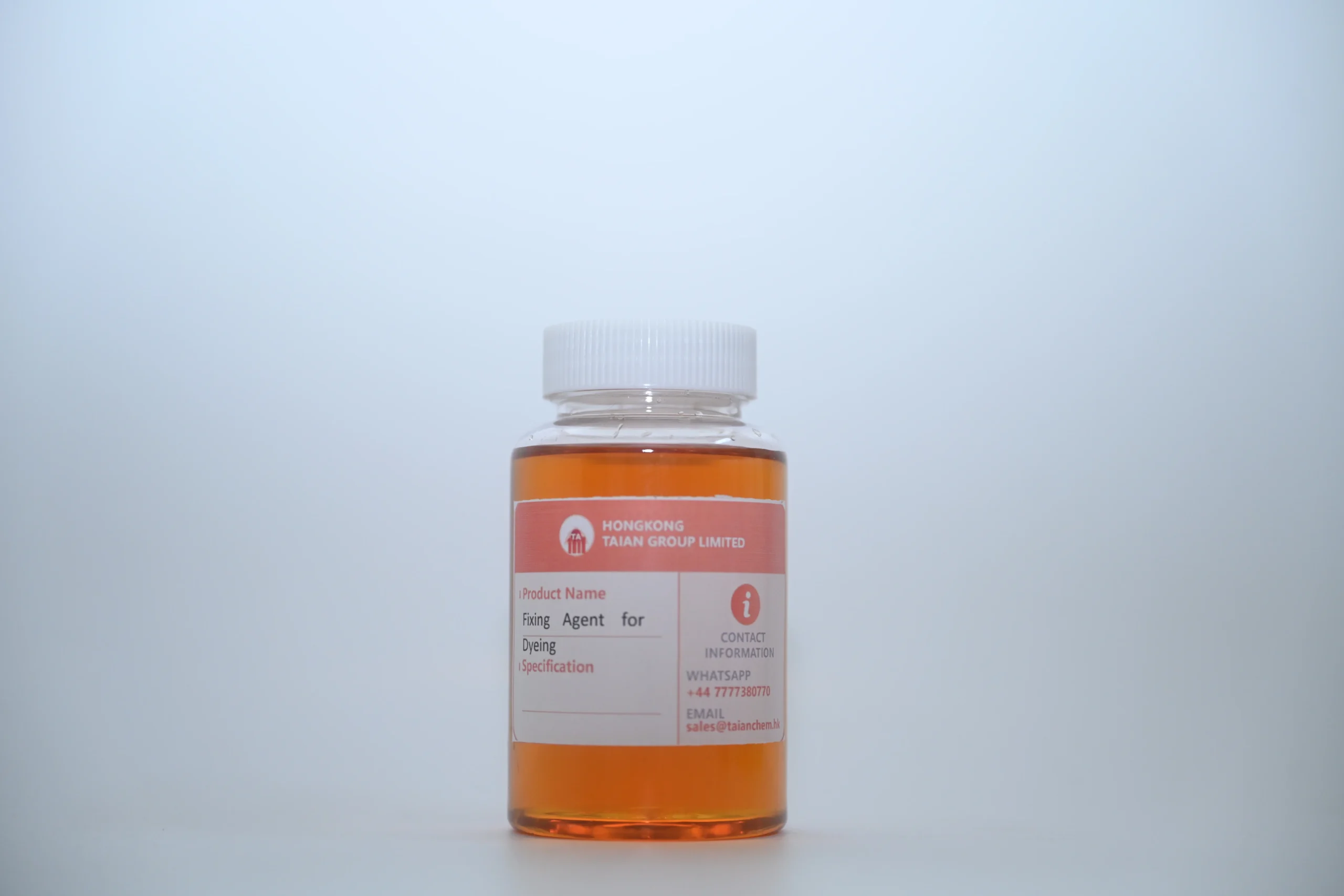
Dyeing fixing agent is a chemical treatment applied after dyeing to improve the fastness properties of dyed fabrics, particularly wet fastness (washing, water, and perspiration resistance). The agent works primarily with ionic dyes like reactive and direct dyes that have anionic (negatively charged) groups. Fixing agents are typically cationic (positively charged) polymers that form ionic bonds with these anionic dyes, creating salt-like complexes that are much more resistant to water and washing than the original dye-fiber bonds alone. Advanced fixing agents also contain reactive groups that can form covalent bonds with both the dye molecules and the cellulose fibers, creating a three-component complex (fiber-dye-fixer) that is extremely wash-stable. The best fixing agents achieve this improvement without causing significant shade changes, fabric stiffness, or reduction in other fastness properties like lightfastness.
What are the Applications of Dyeing Fixing Agent?
Dyeing fixing agents are essential in cotton and cellulosic fiber dyeing where high wet fastness is required. For fashion garments that will be frequently washed, fixing improves durability and maintains appearance through multiple laundry cycles. Home textiles like bed linens, towels, and curtains particularly benefit, as these items undergo regular washing and consumers expect lasting color. Dark shades, which typically have higher levels of unfixed dye, especially need fixing treatment to prevent bleeding onto lighter items in mixed loads. Export-oriented textile manufacturers use fixing agents to meet stringent international standards – European and Japanese markets particularly enforce strict fastness requirements. In garment dyeing operations, where piece-dyeing occurs after garment construction, fixing agents prevent color bleeding at seams and collars. Athletic wear and functional textiles benefit from improved perspiration fastness provided by fixing agents.
Product Detail Images:
Image 1: Dyeing fixing agent in industrial packaging
Image 2: Laboratory fastness testing equipment and results
Image 3: Molecular bonding diagram showing fixing mechanism
Application Scenario Images:
Image 1: Exhaust dyeing machine applying fixing agent
Image 2: Continuous padding line for fixing agent application
Image 3: Quality control testing showing fastness improvement results
Video Demonstrations:
Application process video for exhaust and continuous methods
Wash fastness testing demonstration showing before/after improvement
Textile dyehouse testimonial about quality enhancement and reduced re-work