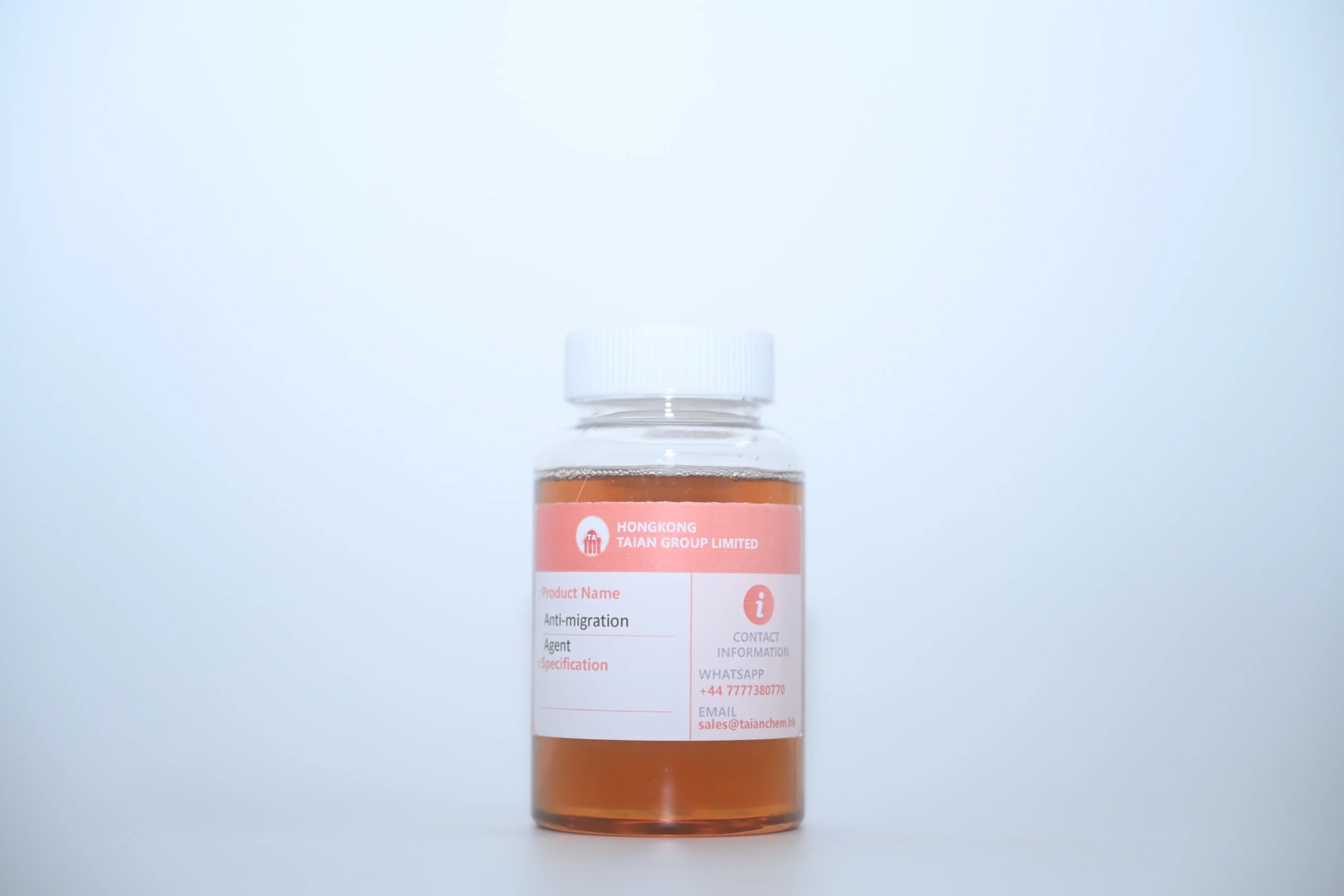

In textile dyeing and finishing, maintaining precise color placement is essential for achieving high-quality results. The Anti-migration Agent is specifically formulated to prevent unwanted dye movement during critical stages such as drying, thermofixation, and high-temperature processing. Without the proper control mechanism, dyes may naturally migrate from regions of higher concentration to areas with lower concentration, especially when the fabric is exposed to heat or moisture fluctuations. This phenomenon can lead to patchy areas, blurred outlines, or overall dullness in the final coloration.
The Anti-migration Agent works by forming a protective, stabilizing layer around dye particles, effectively immobilizing them during the drying or fixation stage. This helps maintain the integrity of the dye distribution established during the earlier dyeing steps. As the fabric undergoes heat exposure, the agent ensures that dye molecules stay locked in their intended positions, resulting in clean, crisp, and uniform color effects. Manufacturers using this additive benefit from reduced dye bleeding, improved clarity of patterns, and enhanced overall fabric appearance.
Achieving shade consistency is one of the most critical and challenging aspects of textile dyeing. Even slight variations in temperature, pressure, liquor ratio, or drying speed can lead to inconsistent color outcomes. Deep, dark, or highly saturated colors are particularly vulnerable to shade discrepancies because even minor dye migration can cause visible differences across the fabric surface.
The Anti-migration Agent plays a central role in addressing these challenges. By slowing down dye mobility and minimizing the risk of back-staining, the agent promotes even dye distribution throughout the fabric. This results in smoother gradients, more uniform saturation, and reduced streaking or blotching. The improvement is especially noticeable in continuous dyeing ranges, where fabrics move rapidly through padding, squeezing, and drying stages that can easily trigger migration issues.
For polyester, cotton blends, viscose, and synthetic fiber systems—where capillary action and diffusion often contribute to unpredictable shade movement—the Anti-migration Agent acts as a stabilizing buffer. Its ability to control dye dispersion ensures that the fabric maintains consistent coloration not only within a single batch but also across multiple production runs. This significantly reduces the risk of shade variation between rolls or lots, a factor that is crucial for maintaining brand quality and meeting buyer specifications.
High-temperature drying, heat-setting, and thermosol processes are standard in modern textile manufacturing, but they also present a high risk of dye migration. As heat causes dye molecules to mobilize, the color may shift within the fibers or redeposit unevenly on the surface. This can result in poor colorfastness, irregular shades, or weak fixation.
The Anti-migration Agent enhances fixation efficiency by stabilizing dye placement before and during thermal exposure. By effectively “locking” the dye molecules in their original dyed zones, it ensures that the fixation process proceeds with maximum uniformity. This enables dyes to bond more securely to the fibers, leading to:
Better penetration control, preventing overloaded or under-penetrated areas.
Improved wash fastness, as dyes remain evenly fixed and less likely to bleed during laundering.
Enhanced appearance, with sharper color clarity and minimized mottling.
Because the agent reduces the need for reprocessing caused by shade irregularities, it also helps streamline production and reduce material waste. This is especially valuable for large-scale dye houses, where efficiency plays a significant role in operational costs and output consistency.
The versatility of the Anti-migration Agent is one of its strongest advantages. It is engineered to function effectively across a wide range of dye classes, including:
Disperse dyes used primarily on polyester
Reactive dyes widely applied on cotton and cellulose fibers
Vat dyes, which require oxidation and pose challenges for shade control
Sulfur dyes, known for their migration tendencies during drying
Pigment padding systems, where binder migration can cause uneven coloration
Additionally, its low-foaming properties make it ideal for continuous dyeing machines, where excessive foam can disrupt fabric movement and cause mechanical issues. Its excellent dispersibility ensures that the agent spreads evenly throughout the dye bath or padding liquor, maintaining stable performance regardless of the processing conditions.
The Anti-migration Agent does not alter shade brightness, designed color tone, or the hand feel of the fabric. This ensures high formulation compatibility and allows dye houses to integrate it seamlessly into existing production recipes without needing to reformulate dyes or auxiliaries. Whether used in thermosol dyeing, pad-dry processes, or high-temperature fixation systems, the agent consistently delivers reliable performance.
As the global textile industry becomes increasingly quality-driven and efficiency-focused, manufacturers face continuous pressure to reduce defects, improve reproducibility, and maintain strict shade control. The Anti-migration Agent plays a crucial role in meeting these expectations.
By preventing dye movement and enhancing stability, it helps reduce common issues such as uneven shades, side-center variations, streaks, and roller marks. This supports greater process reliability and minimizes time-consuming shade corrections, machine stoppages, or re-dyeing operations. In large-scale textile mills, even a modest reduction in rework can translate into significant cost savings and productivity improvements.
This agent is suitable for a wide range of applications, including apparel textiles, home furnishings, upholstery materials, sportswear, and industrial fabrics. From fashion brands demanding perfect shade uniformity to technical textile producers requiring dependable colorfastness, the Anti-migration Agent strengthens dyeing reliability and elevates overall product value.
With its ability to stabilize dyes, enhance uniformity, and improve heat fixation performance, the Anti-migration Agent is an essential additive for modern textile dyeing. Its broad compatibility with multiple dye systems, low interference with fabric properties, and strong support for high-quality production standards make it a valuable tool for achieving consistent, defect-free, and visually appealing results.