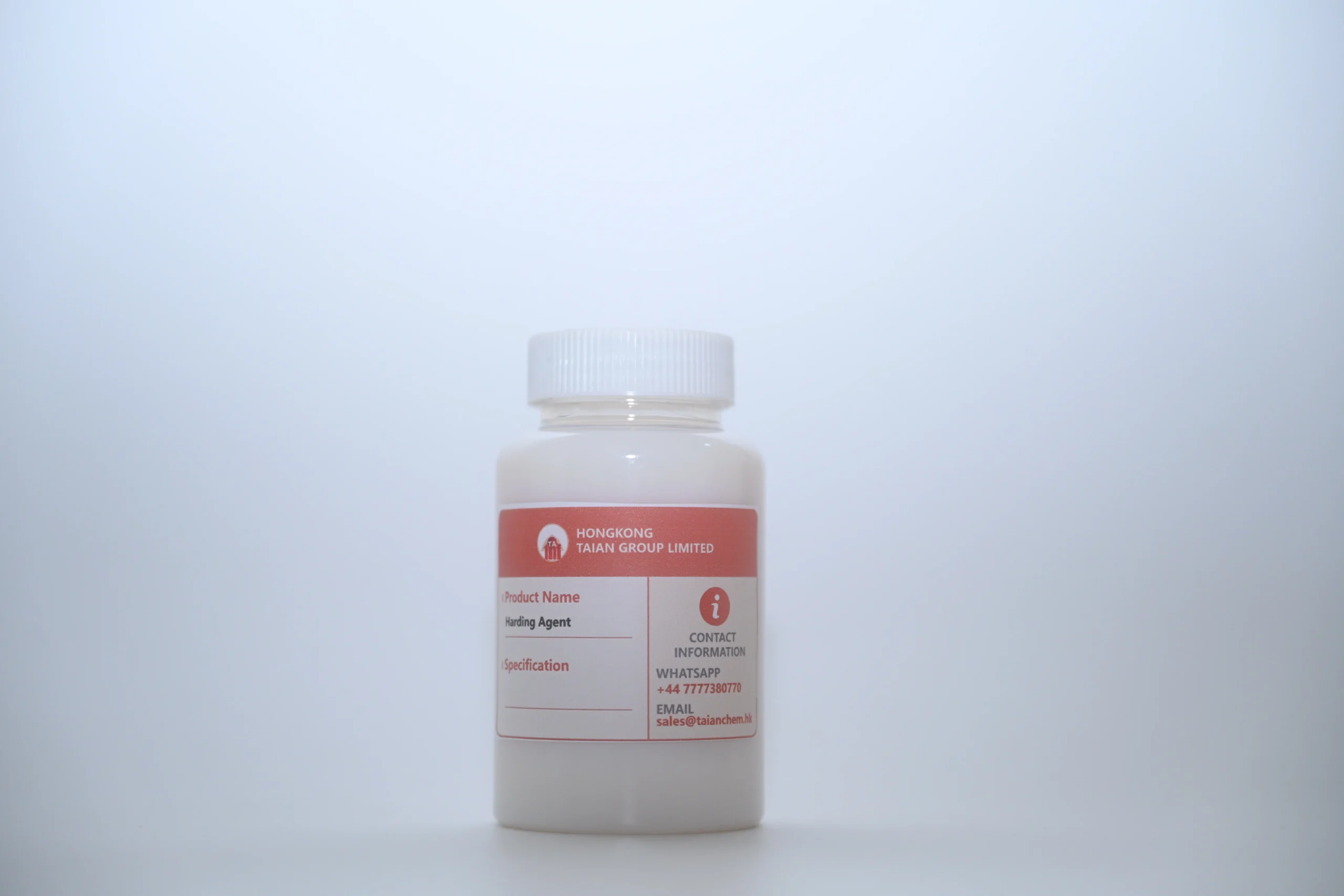

Our professional-grade Hardening Agent is an advanced textile finishing auxiliary specifically engineered to optimize the physical architecture of fabrics. By reinforcing fiber bonding and enhancing surface strength, it significantly increases fabric firmness and structural stability. This high-performance solution is ideal for garments and technical textiles that demand superior shape retention and reduced deformation without sacrificing essential flexibility or user comfort.
Designed for versatility and efficiency, the Hardening Agent creates a consistent polymeric network on the fiber surface, resulting in a smooth, uniform appearance and enhanced abrasion resistance. Whether used for high-end uniforms, industrial workwear, or home upholstery, this agent ensures a durable finish that resists wrinkling and mechanical stress, providing a practical solution for manufacturers seeking a perfect balance between fabric body and longevity.
Detailed Parameters
| Appearance | Milky white to translucent liquid | Ionic Character | Non-ionic or weakly anionic |
|---|---|---|---|
| Solubility | Dispersible in water | pH Value | Mildly acidic to neutral |
| Recommended Fibers | Cotton, polyester, blends, viscose, industrial textiles | Application Methods | Padding, exhaust, continuous finishing |
| Compatibility | Resins, softeners, most finishing agents | Thermal Stability | Excellent resistance to drying/curing temps |
| Storage Stability | Stable under normal conditions; no phase separation | Form | Liquid for precise dosage control |
Key Advantages
Structural Stability
Significantly increases fabric firmness and reduces sagging or stretching for a crisp, professional look.
Wrinkle Resistance
Improves the fabric’s ability to resist creasing and wrinkling, ensuring long-lasting garment aesthetics.
Uniform Film-Forming
Creates a stable polymeric network on fibers for an even appearance and enhanced surface strength.
High Abrasion Resistance
Reinforces the textile surface, making it ideal for heavy-duty workwear and industrial applications.
Process Adaptability
Fully compatible with padding, exhaust, and continuous lines, integrating seamlessly with other auxiliaries.
Cost-Efficient Production
Stable performance reduces quality variations and reprocessing, optimizing overall operational costs.
Product Gallery
Management Platforms
Dosage Precision
Liquid form allows for precise dilution and control based on desired fabric stiffness.
Process Integration
Easily blends with resins and softeners in existing textile production lines.
Quality Control
Consistent chemical composition ensures uniform results across large-scale batches.
Thermal Stability
Maintains stability during high-temperature drying and curing stages.
Material Compatibility
Effective across a wide range of fibers including cotton, polyester, and viscose.
Storage Management
Long-term stability in cool, dry environments prevents phase separation.
Investment Return Comparison
| Performance Metric | Standard Auxiliaries | Our Hardening Agent |
|---|---|---|
| Shape Retention | Moderate | Superior |
| Processing Time | Standard | Optimized/Faster |
| Quality Consistency | Variable | Highly Stable |
| Fabric Durability | Basic | Enhanced Abrasion Resistance |
| Reprocessing Rate | Higher | Significantly Lower |
Frequently Asked Questions
While softeners focus on enhancing hand-feel and flexibility, the Hardening Agent is designed to increase fabric body, stiffness, and dimensional stability, preventing the fabric from stretching or sagging.
It is highly effective for cotton, polyester, viscose, blended fabrics, and specialized industrial textiles used in workwear and upholstery.
Yes, our Hardening Agent is designed for excellent compatibility and can be integrated with softeners, resins, and anti-wrinkle agents to achieve customized fabric properties.
The agent is compatible with padding, exhaust application, and continuous finishing lines. We recommend optimizing concentration and curing temperature based on the specific fiber type.
The degree of hardness is controllable via dosage. We suggest starting with a lower concentration and performing a gradient test to find the ideal balance between structure and comfort.
Yes, when stored in a cool and dry environment, the product maintains long-term stability without phase separation, ensuring consistent performance throughout its shelf life.