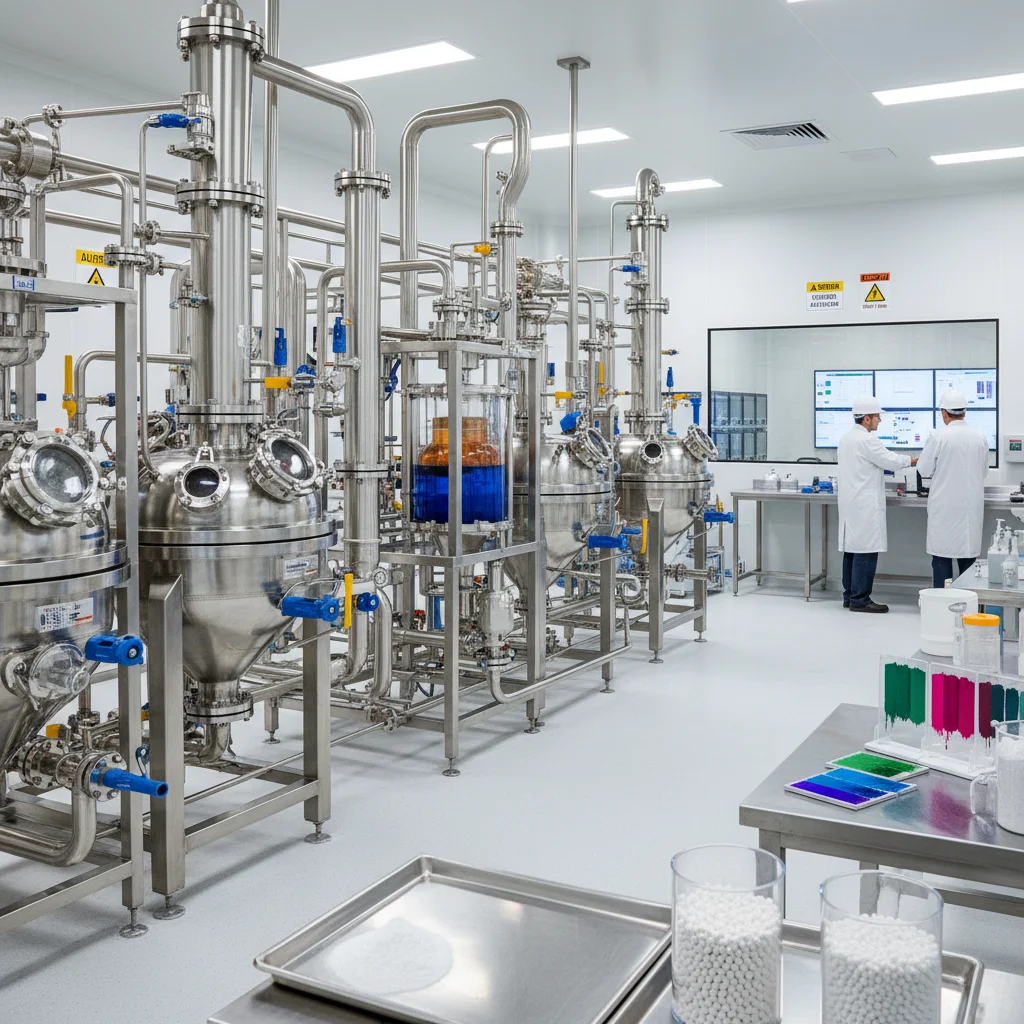
High-alkali pretreatment places particular demands on wetting and penetrating agents. In processes such as mercerizing and alkaline scouring, the working bath may contain a high concentration of caustic soda, while the fabric still needs to be wetted quickly and uniformly.
When wetting is insufficient, the treatment liquor may not penetrate the fabric evenly. This can result in inconsistent pretreatment and may later appear as uneven dyeing, shade variation or patchy areas. Increasing the dosage of a conventional wetting agent does not necessarily solve the problem, especially if the surfactant system itself has limited stability under strong alkaline conditions.
An alkali-resistant penetrating agent is designed for these demanding alkaline baths. It helps the treatment liquor spread rapidly across the fabric and penetrate more uniformly while maintaining wetting performance in the presence of concentrated alkali. Depending on the formulation, it can also provide dispersing, emulsifying and detergency functions, making it suitable for processes such as alkaline scouring, bleaching and mercerizing.
For production use, however, alkali resistance should not be judged by product description alone. Caustic soda concentration, dosage, temperature, fabric construction and the other auxiliaries in the bath can all affect actual wetting performance. These factors should be checked under the mill's own process conditions.
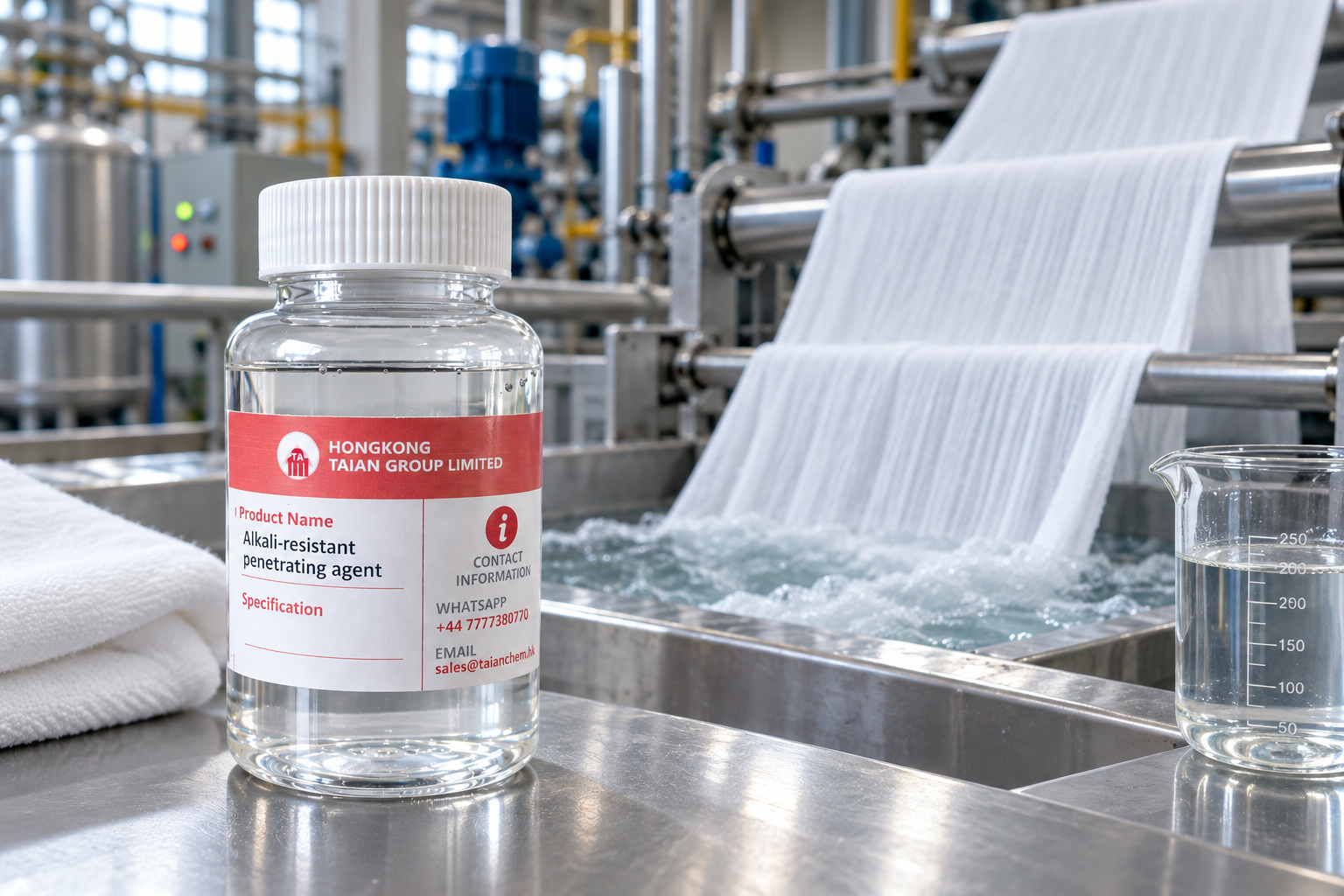
Why Alkali Resistance Matters in Textile Pretreatment
The key challenge is not simply achieving fast initial wetting. The penetrating agent must retain its wetting ability while exposed to concentrated sodium hydroxide and other chemicals present in the pretreatment bath.
Conventional wetting agents may show reduced performance or limited stability under strongly alkaline conditions. When penetration is insufficient, the treatment liquor may not distribute evenly through the fabric structure, which can affect pretreatment uniformity and subsequent dyeing consistency.
Our alkali-resistant penetrating agent is designed for use under demanding alkaline conditions. It has good resistance to concentrated alkali, elevated temperature, oxidizing and reducing agents, and hard water. In addition to wetting and penetration, it provides emulsifying, degreasing, detergency, dispersing and antistatic functions, making it suitable for the formulation of alkaline scouring and mercerizing auxiliaries.
The product also shows good stability toward hydrogen peroxide, which can be useful in peroxide-containing alkaline pretreatment systems. Actual performance should be evaluated according to the peroxide concentration, alkali level and operating conditions used in the mill.
Penetration Performance Under High-Alkali Conditions
Rapid penetration under concentrated alkali is one of the key performance characteristics of this product. In our product test, a penetration time of ≤3 seconds is achieved at a dosage of 5 g/L in a 300 g/L NaOH solution.
This result demonstrates that the product can maintain rapid wetting performance even under highly alkaline conditions. Actual performance in production may vary depending on fabric construction, bath temperature, chemical composition, water quality and equipment conditions.
Beyond penetration, the product also provides emulsifying, degreasing, detergency, dispersing and antistatic functions under strong alkaline conditions. These properties make it particularly useful as a raw material for alkali-resistant scouring agents and mercerizing penetrant formulations.

Technical Parameters
The following values provide a practical reference for product evaluation and incoming quality control. Final specifications should be confirmed against the latest TDS and batch COA.
| Parameter | Unit | Value |
| Appearance | — | Colorless to light yellow transparent liquid (Typical value, please refer to the latest TDS/COA) |
| Odor | — | Odor-free |
| pH value | — | 6.0‑7.0 |
| Solid content | % | 45±2 |
| Stability | 3000 rpm, 10 min | No delamination, no precipitation |
Technical Parameters for Industrial Production
The product has a solid content of 45 ± 2% and a pH value of 6.0–7.0. These parameters can be used as part of routine incoming quality control and batch evaluation before production.
In the stability test specified in the TDS, the product shows no phase separation or precipitation after centrifugation at 3000 rpm for 10 minutes. For production use, actual storage and bath stability should still be evaluated under the conditions of the intended formulation.
The product can be used directly as a penetrating agent or as a raw material for formulating alkali-resistant scouring agents and mercerizing penetrants.
Application Methods and Dosage
The appropriate dosage depends on the alkali concentration, fabric construction, required penetration performance and overall process formulation.
For direct use, a dosage of 5–10 g/L is recommended as a reference. The actual dosage should be adjusted according to the process requirements and confirmed through production trials.
When used as a formulation component, the recommended addition level is 5%–50% (o.w.f.), depending on the penetration performance required in the finished auxiliary formulation.
Before bulk production, we recommend carrying out a small-scale trial under the mill's actual process conditions. Alkali concentration, temperature, fabric construction, water quality and other auxiliaries in the bath may all influence the final wetting and penetration performance.

Process Compatibility & Application Advantages
This high-efficiency alkali-resistant penetrating agent is perfectly adapted to modern high-alkali textile pretreatment processes, including mercerizing, heavy-alkali scouring and high-temperature bleaching.
It features low foam, fast penetration and strong tolerance to high-concentration caustic soda and hard water, solving common production problems such as incomplete wetting, inconsistent pretreatment and poor dyeing reproducibility.
Compatible with most anionic and non-ionic textile auxiliaries, it can be freely matched with scouring agents, bleaching stabilizers and detergents to optimize overall pretreatment effects and reduce production defect rates.
FAQ
Q1: What type of surfactant is the Alkali-Resistant Penetrating Agent?
It is an anionic surfactant designed for wetting and penetration under strongly alkaline conditions. It also provides emulsifying, degreasing, detergency, dispersing and antistatic functions.
Q2: How does it perform under concentrated alkali conditions?
According to the product TDS, the penetration time is ≤3 seconds at a dosage of 5 g/L in a 300 g/L NaOH solution. Actual performance in production may vary depending on fabric construction, temperature, bath composition and equipment conditions.
Q3: What dosage is recommended for direct use?
For direct use, 5–10 g/L can be used as a reference dosage. The final dosage should be adjusted according to the required penetration performance and actual process conditions.
Q4: Can it be used to formulate other pretreatment auxiliaries?
Yes. The product can be used as a raw material for formulations such as alkali-resistant scouring agents and mercerizing penetrants. The TDS gives a reference addition range of 5%–50% (o.w.f.), depending on the required penetration performance.
Q5: Can it be used in peroxide-containing systems?
The product shows good resistance to oxidizing agents and has a stabilizing effect toward hydrogen peroxide according to the product TDS. However, peroxide stability depends on the complete bath formulation and process conditions, so performance should be confirmed through application testing.
Q6: What should be done if the product has passed its shelf life?
Check key indicators such as solid content and penetration performance before reuse. If the results remain within the required specification, suitability can then be evaluated for the intended application.
Contact Us
If you are evaluating an alkali-resistant penetrating agent for high-alkali textile pretreatment, scouring or mercerizing, you can provide us with your fabric type, NaOH concentration, process temperature and current operating conditions.
Our technical team can provide product information, TDS/SDS documentation and samples for laboratory or mill evaluation.