
Uneven whiteness. Poor capillary absorbency. Batch-to-batch shade differences. Foam spilling out of the padder trough. These are everyday headaches in cotton, linen, viscose, and cellulosic blend pretreatment. Many mills check the dyeing recipe first. But the root cause often sits earlier—the scouring and refining auxiliary doesn't match the pretreatment route.
When mills switch or re-evaluate pretreatment chemicals, two anionic refining agents usually come up for comparison: Cold Pad-Batch Refining Agent, built for low-temperature cold pad-batch processes; and Scouring Agent 88, a high-alkali refining agent for continuous high-temperature, high-alkali pretreatment lines. Both handle desizing, scouring, and emulsifying-dispersing functions. But they work in very different bath environments, reaction times, and production targets. Pick the wrong one, and chemical cost goes up, foam becomes hard to control, fabric quality fluctuates, and energy is wasted.
This article puts the two products side by side on the production floor: what process conditions each one fits, how they perform in mill trials, how to troubleshoot common problems, and how to choose based on equipment, fabric structure, energy targets, and quality requirements. Don't make the call based on a product data sheet alone.
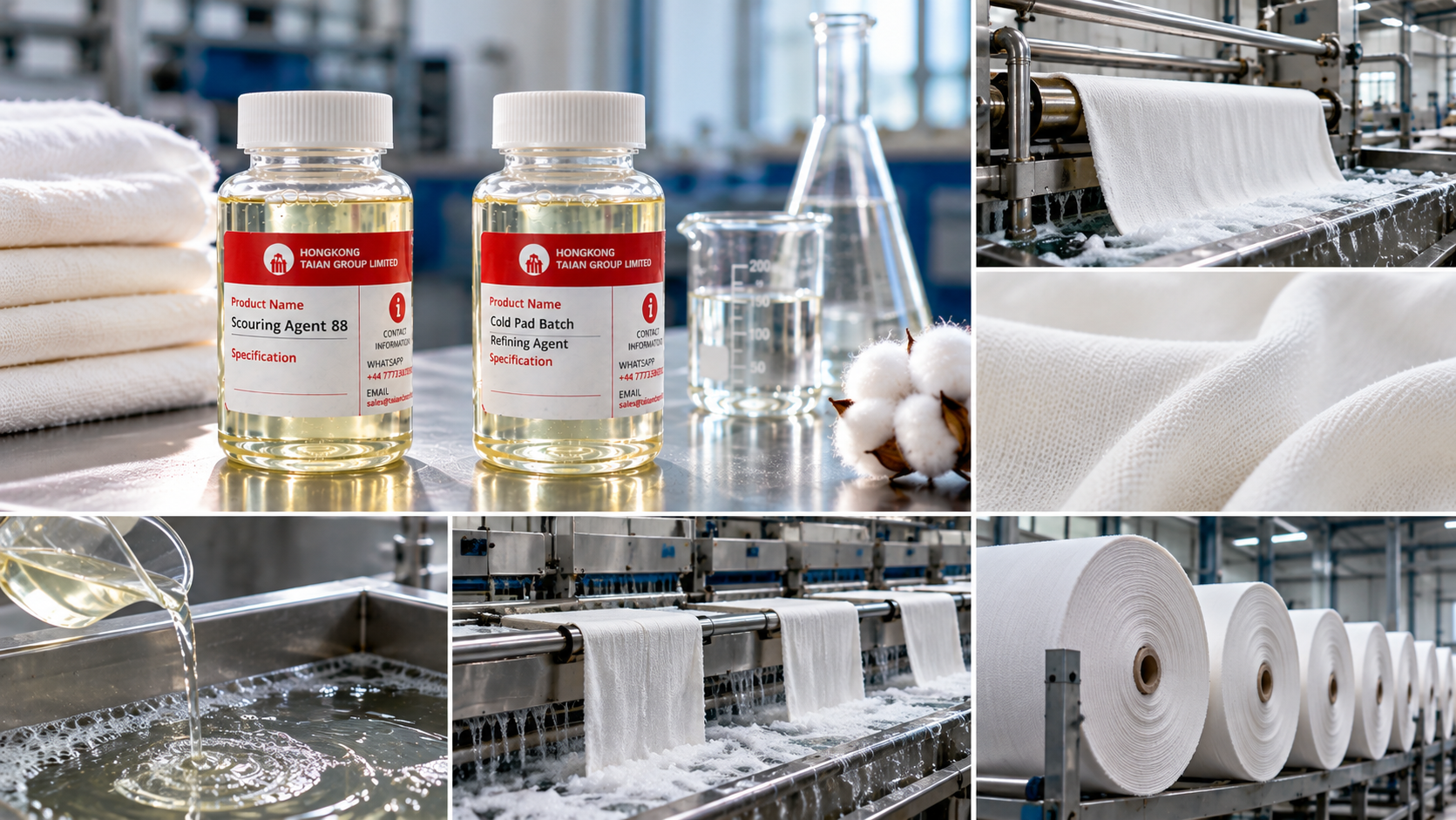
Core Formulation & Functional Profile
Both auxiliaries are phosphorus-free, heavy-metal-free anionic surfactant composites, compliant against mainstream brand RSL / MRSL requirements for export textile production. However, their formulation tuning is optimized for opposing bath conditions.
Scouring Agent 88 (High-Alkali Refining Agent)
Scouring Agent 88 is purpose-built for short-cycle, high-caustic, high-temperature continuous pretreatment baths (desizing, scouring, bleaching combined ranges).
pH value: 6–7, fully soluble in cold and hot water.
Core strengths: retains powerful wetting and penetration efficiency under high caustic loading; balanced emulsification and dispersion for size, wax and natural pectin removal; controlled low-foam performance under recommended dosage.
Compatibility: works alongside caustic soda and hydrogen peroxide in continuous scouring-bleaching baths. Pre-test compatibility for complex mixed-auxiliary formulations before mass production.
Typical starting dosage: 5–10 g/L for combined scouring-bleaching continuous lines.
Many conventional wetting agents rapidly degrade and lose penetration capability as caustic concentration rises in hot pretreatment baths. Operators often attempt to compensate by raising bath temperature or adding extra chemical, which pushes up energy and chemical consumption without fixing uneven scouring. Scouring Agent 88 is formulated to resist this high-alkali performance drop-off, ensuring uniform liquor penetration into yarn and fabric weave structure.
Cold Pad Batch Refining Agent
Cold Pad Batch Refining Agent is engineered exclusively for long-duration low-temperature batching (20–30 °C, 12–24 h holding time) in cold pad-batch pretreatment process.
pH value: 7.0–8.0, freely water-soluble pale-yellow liquid.
Core strengths: sustained wetting, scouring and peroxide-stabilizing performance over extended room-temperature batching cycles; prevents premature hydrogen-peroxide breakdown during fabric roll holding; delivers low-foam behaviour for padding operations.
Compatibility: formulated for alkaline cold pad-batch liquor containing caustic soda and hydrogen peroxide. Always validate full-bath compatibility on-site before bulk run.
Typical starting dosage: 20–40 g/L within standard cold pad-batch liquor formula.
Laboratory testing confirms cold pad-batch reactions are extremely temperature-sensitive: a mere 2 °C drop in batching temperature can extend required holding time by nearly four hours to hit target pretreatment quality. This auxiliary maintains activity across these long, low-temperature hold cycles where standard high-alkali refining agents cannot deliver consistent results.
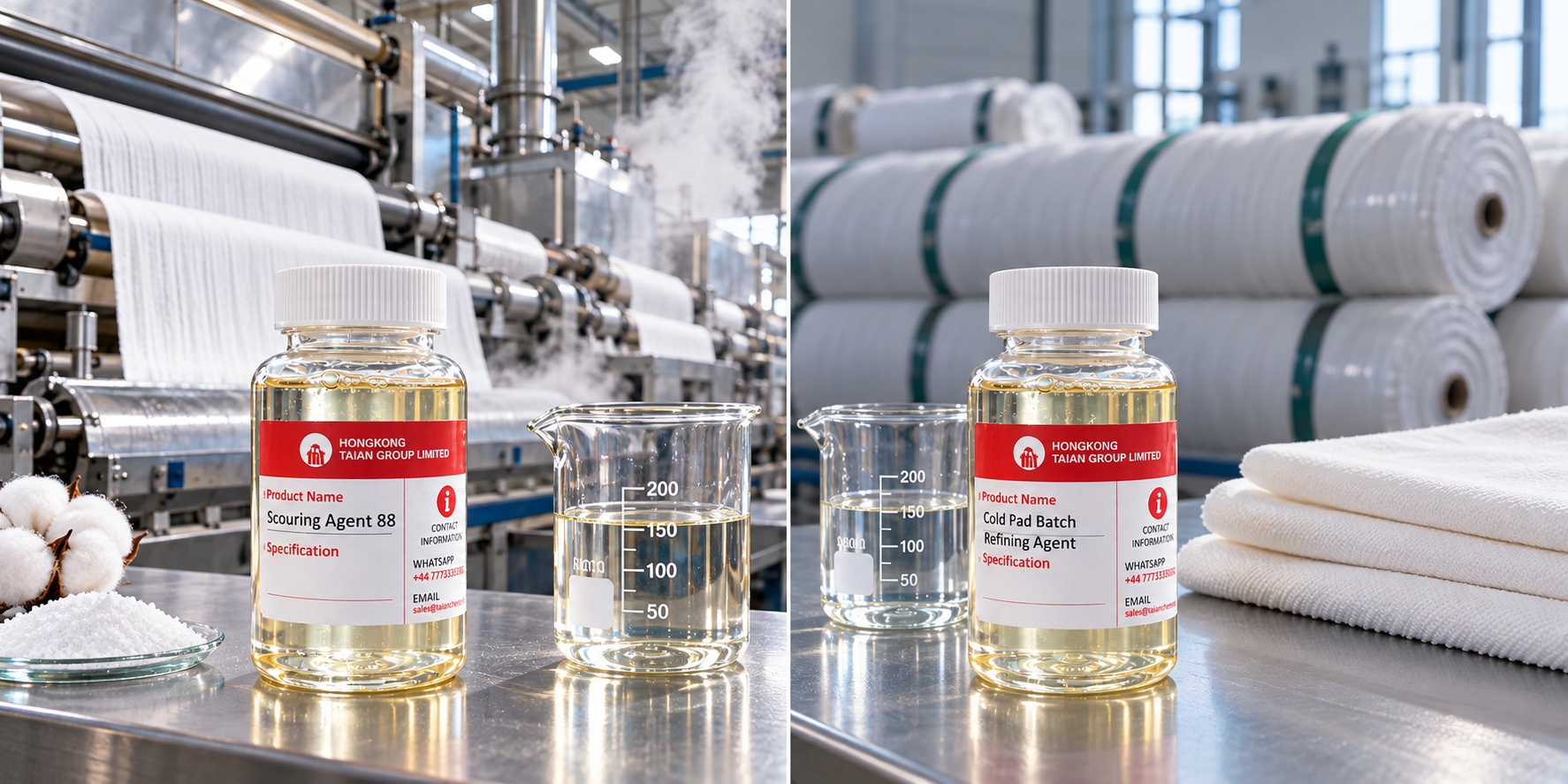
Process Fit & Key Operating Parameters
| Comparison Item | Scouring Agent 88 | Cold Pad Batch Refining Agent |
| Target process | Continuous high-alkali, high-temperature scouring-bleaching | Cold pad-batch low-temperature pretreatment |
| Working temperature | 95–100 °C continuous bath | Batching temperature: 20–30 °C |
| Reaction cycle | Short continuous residence time | Long batching: 12–24 hours |
| Recommended dosage | 5–10 g/L | 20–40 g/L |
| Critical performance | High-caustic resistance, rapid penetration, low-foam padding | Long-term peroxide stabilization, low-temp sustained scouring, roll-batch stability |
| Key equipment | High-temperature steamer, continuous range | Padder + fabric roll batching system + multi-stage washing |
| Best-suited fabrics | Heavy-weight cotton / linen, fabrics with high size & wax content, high-throughput production | Light–medium weight cotton, linen, viscose and cellulosic blends; mills targeting steam & wastewater reduction |
Real-World Mill Case Study Performance
Field trial data highlights the respective strengths of each auxiliary under actual factory conditions. Note: Results are based on specific mill conditions. Actual performance varies with fabric, equipment, water quality, and process control.
Case 1: Scouring Agent 88 — North-China Woven Cotton Mill
A woven cotton mill deployed Scouring Agent 88 at 5–10 g/L on its existing continuous scouring-bleaching production line.
Improvements: Markedly enhanced whiteness uniformity and fabric capillary effect; pretreatment-related fabric defects dropped significantly.
Operational gain: Foam accumulation inside the padder trough became easier to manage. Operators spent far less time troubleshooting foam disturbances, and batch-to-batch fabric quality stability improved.
Technical Insight: The mill previously tried to solve uneven pretreatment by simply increasing auxiliary dosage, which only generated excess foam and unstable liquor pick-up. Standardizing bath preparation and switching to an alkali-resistant Scouring Agent 88 delivered better outcomes than temperature tuning or chemical over-dosing.
Case 2: Cold Pad Batch Refining Agent — Vietnam Export-Oriented Cotton Mill
A 30,000-spindle woven cotton mill for export textiles migrated from traditional high-temperature pretreatment to a cold pad-batch workflow, applying Cold Pad Batch Refining Agent at 30 g/L; batching condition: 25 °C for 18 hours.
Whiteness index (ISO 105-J02): Improved from 72 to 82.
Capillary effect: Rose from 3.2 cm/30 min to 6.1 cm/30 min.
Steam consumption reduction: 32% during pretreatment.
Recorded fabric defect rate: Down over 80% during the evaluation period.
Technical Insight: The 18-hour batching time at 25°C aligns with the product's TDS recommendation (20–30°C for 12–24 hours). The improvement in capillary effect confirms effective removal of natural waxes and pectin under low-temperature conditions. After successful trial verification, the mill rolled this cold pad-batch auxiliary and process across three primary production lines.
Trial Results at a Glance
| Indicator | Cold Pad-Batch Trial (Vietnam) | High-Alkali Trial (North China) |
| Dosage | 30 g/L cold pad batch refining agent | 5–10 g/L high-alkali refining agent |
| Process | 25 °C, 18 h batching | Continuous scouring-bleaching line |
| Whiteness | 72 → 82 (ISO 105-J02) | Uniformity noticeably improved |
| Capillary effect | 3.2 → 6.1 cm/30 min | Improved |
| Steam saving | 32% | — |
| Defect rate | Reduced by >80% | Pretreatment-related defects significantly reduced |
Practical Selection Checklist for Mills
Never base auxiliary purchasing decisions solely on per-kilogram raw material price. A seemingly cheaper scouring agent may demand higher addition rates, trigger heavy foam requiring extra defoamer consumption, or degrade under target bath conditions, lifting your real cost per finished fabric metre. Evaluate in this sequence:
Bath environment matching: confirm auxiliary stability under your actual operating caustic concentration and temperature.
Peroxide compatibility: verify no uncontrolled hydrogen-peroxide decomposition occurs within your full working liquor.
Foam control: assess foam behaviour during padding, circulation and holding; excess foam disrupts uniform liquor pick-up.
Formulation compatibility: test full mixed bath (caustic soda, hydrogen peroxide plus other auxiliaries) to avoid precipitation or phase separation.
Environmental compliance: confirm phosphorus-free, heavy-metal-free documentation and alignment with customer-specific RSL / MRSL restrictions.
Mill-scale trial validation: compare candidate auxiliary side-by-side against your existing product on your own grey fabric. Measure whiteness, capillary absorbency, post-wash residual pH, fabric strength and subsequent dyeing performance.
Troubleshooting Common Pretreatment Issues
Poor penetration / insufficient capillary effect: before raising auxiliary dosage, inspect padder pressure and liquor pick-up, batching time and temperature. Check aged stock solutions before usage.
Excessive padder-trough foam: foam is not automatically caused by defective chemicals. Review product dosage, chemical adding sequence, mechanical agitation and bath-component compatibility. Over-dosing auxiliary to mask uneven pretreatment frequently worsens foam issues.
Uneven fabric whiteness: faulty equipment is often the root cause. Worn padder rollers creating cross-fabric-width pressure fluctuation can produce uneven liquor uptake; repairing equipment often outperforms repeated recipe adjustments.
Bath precipitation / phase separation: usually points to component incompatibility or incorrect addition sequence. Avoid mixing concentrated stock solutions without prior compatibility confirmation; dilute individual chemicals as required before feeding to bath.
High residual alkali on fabric: optimize multi-stage washing parameters (washing temperature, water flow, counter-current washing efficiency and washing stages), do not only adjust scouring-agent dosage. Residual alkali will trigger dye-shade variation in downstream dyeing.
Frequently Asked Questions
Q: Can Scouring Agent 88 replace Cold Pad Batch Refining Agent for cold pad-batch lines? A: Not as a direct drop-in replacement. Scouring Agent 88 targets high-alkali high-temperature continuous pretreatment. Cold pad-batch demands long-term low-temperature peroxide stabilization. If you intend cross-application, complete full-liquor compatibility lab testing first.
Q: Are samples and technical documentation available for these two refining agents? A: Yes. 200 g laboratory evaluation samples are available for both products, paired with complete TDS and SDS documentation. Commercial packaging options include 125 kg plastic drums and 1000 kg IBC tanks; shelf life reaches 12 months under recommended storage conditions.
Q: What key quality indicators should I test to validate pretreatment success? A: Evaluate whiteness uniformity, capillary absorbency, residual fabric pH after washing, and fabric tensile strength. Complete these checks before entering dyeing or printing stages.
Q: Can your technical team support custom recipe optimisation for my mill? A: Yes. Our technical team can adjust pretreatment recipes based on your fabric type, installed equipment, existing bath formulation and production-quality objectives. Pilot trials are strongly advised before mass-production changeover.
Conclusion
There exists no universal best textile refining agent. Scouring Agent 88 and Cold Pad Batch Refining Agent each excel within their intended process boundaries.
Choose Scouring Agent 88 (high-alkali refining agent) if you operate continuous high-temperature pretreatment ranges, process heavy-weight fabrics with high size and wax contamination, and require fast-throughput mass production. Its high caustic resistance and controlled-foam profile stabilize quality in harsh hot alkaline baths.
Select the Cold Pad Batch Refining Agent when your priorities are steam-energy savings, lower wastewater discharge, processing light-to-medium-weight cellulosic fabrics, and consistent batch-to-batch whiteness under low-temperature long-hold batching. This solution requires strict process discipline for wet pick-up, roll-winding tension, batching temperature and multi-stage washing.
Regardless of which pretreatment route your mill runs, lab-scale and on-site mill trials are non-negotiable. Always validate performance on your actual grey fabric, local water quality and existing equipment before implementing full-production changes. If you would like to explore sample evaluation or recipe consultation for your pretreatment line, feel free to reach out to our technical support team.
Related Posts
-
Advancing Sustainability Through Efficient Strategies for Reducing Chemicals
-
Understanding The Significance Of Both Oxidising And Reducing Agent In Modern Applications
-

Navigating the Complexities of textile auxiliary chemicals manufacturer and Application
-
High Performance Textile Chemicals and Auxiliaries Guide