Wetting Problems Often Begin Before Dyeing
Uneven dyeing is not always caused by the dyeing process itself. Sometimes, the problem begins earlier, when the pretreatment liquor fails to penetrate the fabric evenly.
A fabric may appear wet on the surface, yet the liquor may not have reached every part of its yarn structure. This can affect sizing removal, scouring efficiency and bleaching uniformity. The consequences may only become visible later as inconsistent absorbency or uneven dye uptake.
Increasing chemical dosage does not necessarily solve the problem. If the treatment liquor cannot penetrate the fabric effectively, additional chemicals may increase processing costs without improving uniformity.
For textile mills, the choice of a suitable wetting agent is therefore an important part of pretreatment control. The objective is not simply to achieve rapid surface wetting, but to obtain effective penetration under the actual processing conditions.
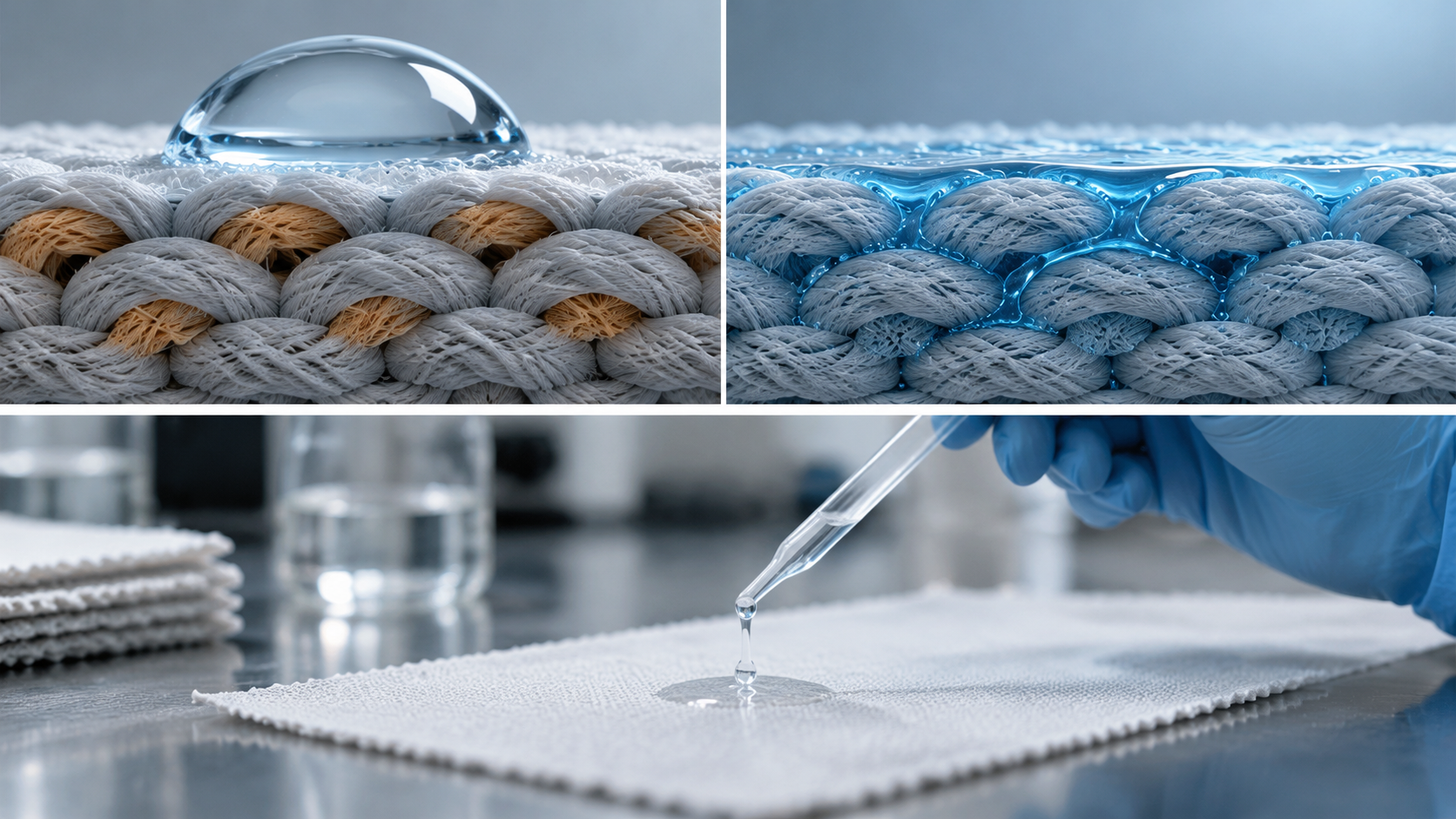
Laboratory evaluation of rapid wetting agent penetration on textile substrates.
How Uneven Penetration Affects Pretreatment Quality
Each pretreatment stage places different demands on liquor penetration. During desizing, the treatment liquor needs to reach sized yarns to support sizing removal. In scouring, effective wetting helps the alkaline bath contact oils, waxes and other impurities. During bleaching, uneven liquor distribution may lead to inconsistent whiteness.
Wetting is only one factor involved. Fabric construction, water quality, chemical concentration, temperature and machine conditions can all influence the result. When pretreatment performance varies, these factors should be considered together rather than assuming that the wetting agent is the sole cause.
A suitable textile penetrating agent helps the treatment liquor spread across the fabric and enter its yarn structure. However, rapid initial wetting does not necessarily mean that penetration will remain effective throughout the process. The product must also be compatible with the working bath and the other auxiliaries in the formulation.
Why Alkali Stability Is a Critical Consideration
In textile pretreatment, a wetting agent may be exposed to high alkali concentrations, elevated temperatures and other auxiliaries. A product that performs well in water may behave differently in a concentrated alkaline bath.
This is particularly important in cotton scouring and mercerization, where sodium hydroxide concentrations can be high. The wetting agent must remain suitable for the actual working conditions, not just perform well in a simple laboratory test.
Water quality and chemical compatibility also deserve attention. Dissolved salts and other auxiliaries can affect bath stability, while incompatible products may cause precipitation or reduce wetting performance. Anionic wetting agents, for example, require particular care when combined with cationic auxiliaries.
When investigating poor wetting in an alkaline process, check the alkali concentration, temperature, water quality and compatibility of the existing formulation. These factors help identify whether the problem lies with the wetting agent itself or with the overall process conditions.
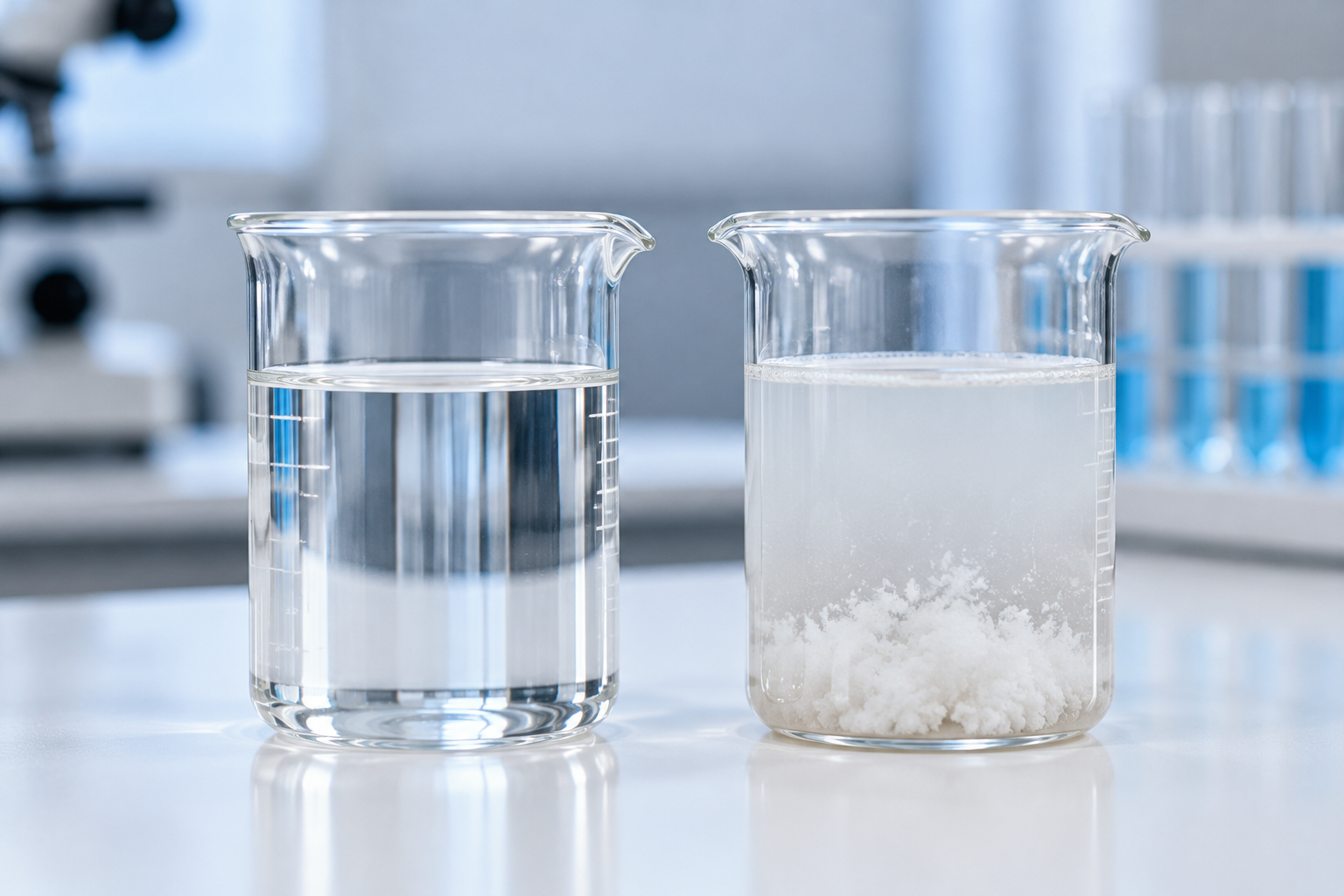
Evaluating the solubility and stability of the rapid wetting agent under laboratory conditions.
Rapid Wetting Agent (Universal): Designed for Alkaline Pretreatment
Rapid Wetting Agent (Universal) is an anionic surfactant developed for textile pretreatment, including desizing, scouring and bleaching.
According to the product information, its 1% aqueous solution achieves a penetration time of less than five seconds under the specified test conditions. The product is also designed for alkaline applications, with a stated sodium hydroxide tolerance of 80–100 g/L. Actual performance depends on the fabric, bath composition and operating conditions, so these figures should be treated as reference values rather than guaranteed production results.
The product also offers emulsifying and dispersing assistance during pretreatment. Its role is to support the overall process, not automatically replace a dedicated scouring agent.
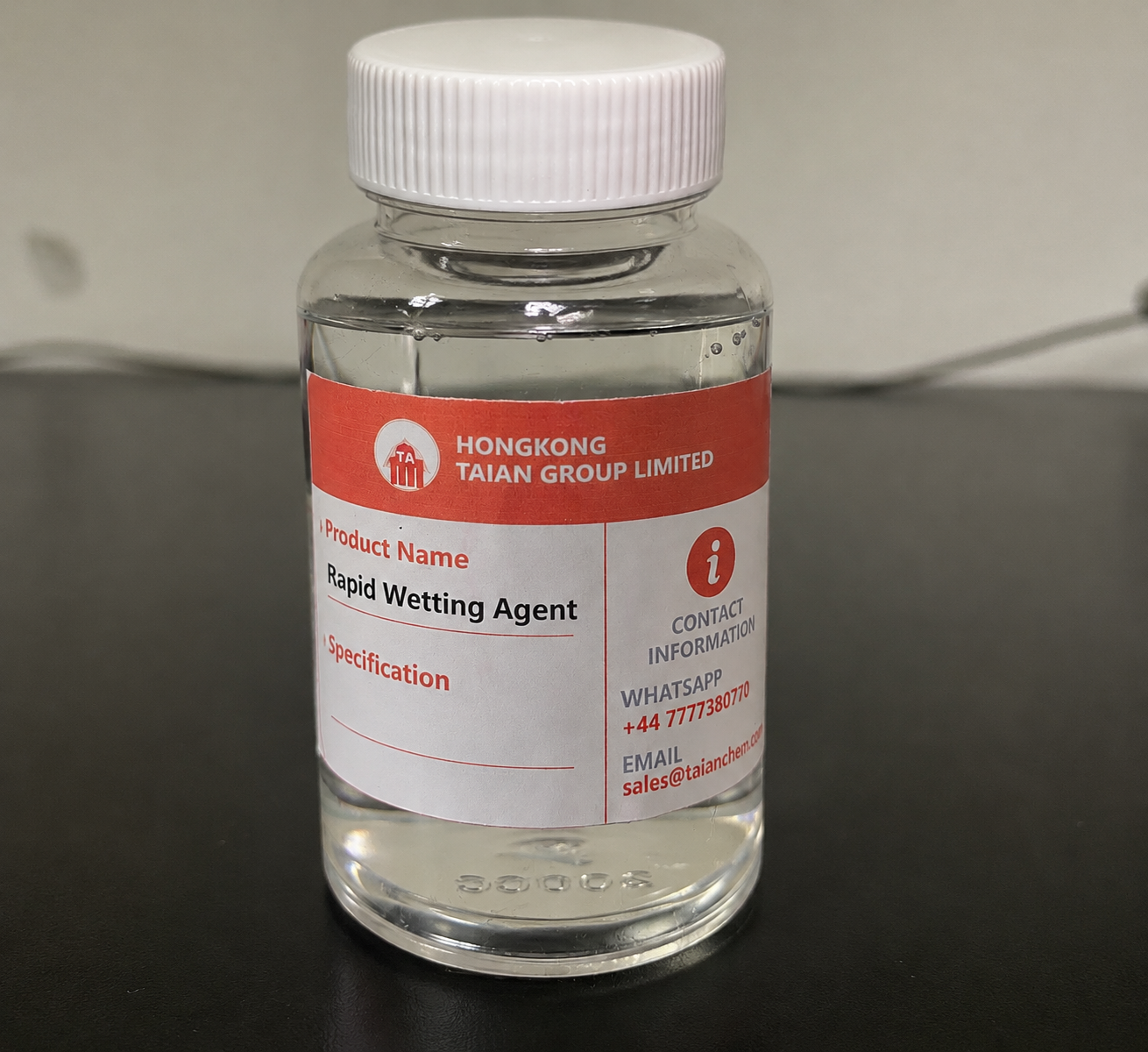
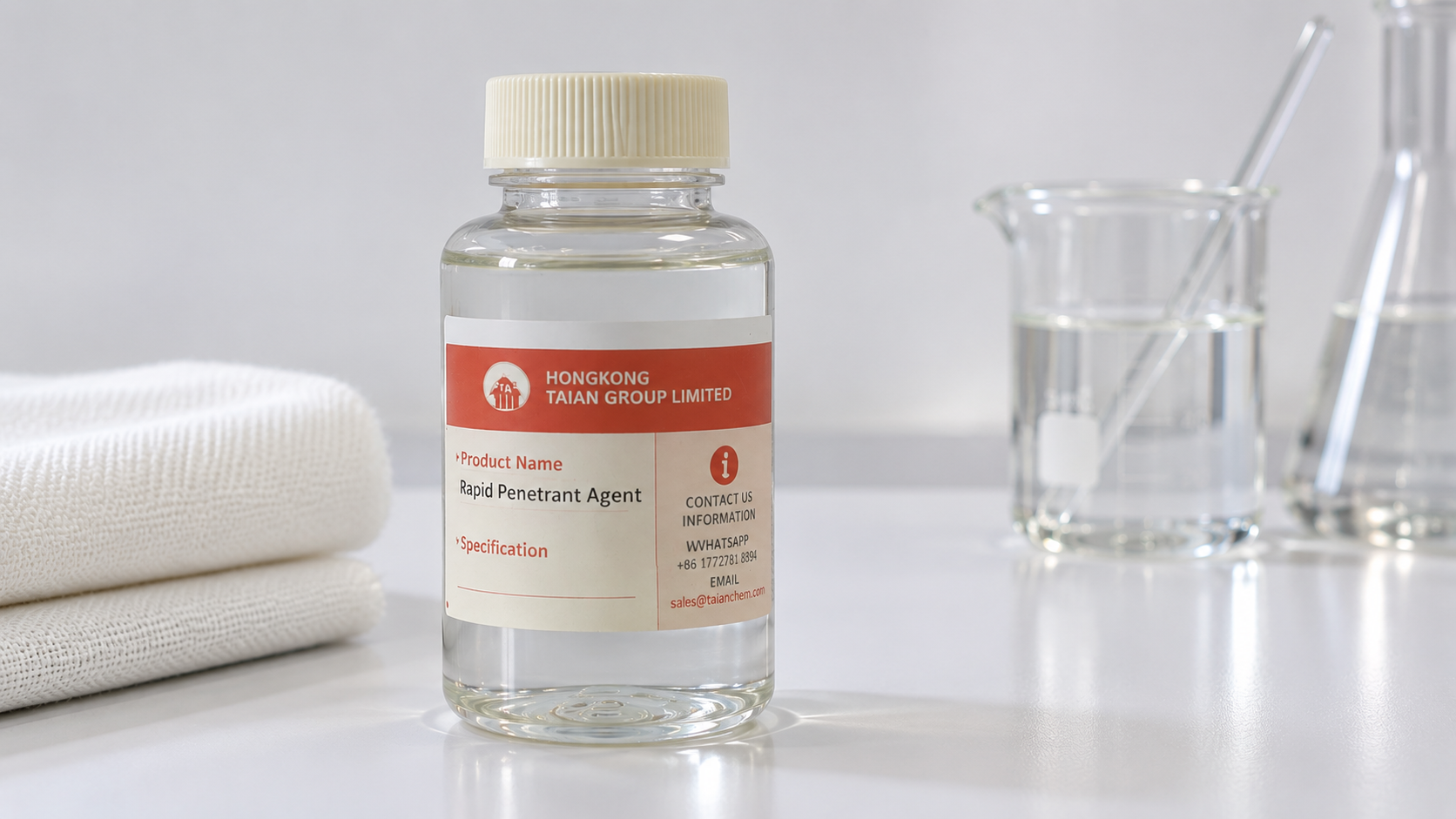
Rapid Wetting Agent (Universal) — designed for alkali-stable textile pretreatment.
Evaluating Wetting Performance Beyond the Laboratory
A rapid wetting result in water does not necessarily predict performance in a concentrated alkaline bath. Fabric construction, chemical concentration, temperature and water quality can all affect liquor penetration during production.
Compatibility is equally important. A wetting agent may be used alongside scouring agents, detergents and peroxide stabilizers, depending on the recipe. However, products should not be assumed compatible simply because they are commonly used in textile pretreatment. Anionic and cationic auxiliaries, in particular, require careful compatibility testing.
For this reason, product selection should be based on performance in the intended working formulation, rather than on wetting speed or alkali tolerance alone. The next step is to compare the candidate product with the existing auxiliary under equivalent processing conditions.
Emulsification and Dispersing Assistance
Some wetting agents also help disperse oily impurities and other materials released during pretreatment. This can support the overall cleaning process, although the result depends on the nature of the impurities and the other chemicals in the formulation.
A dedicated scouring agent may still be necessary to achieve the required cleaning performance. Product selection should be based on the needs of the complete process rather than on a single auxiliary's stated functions.
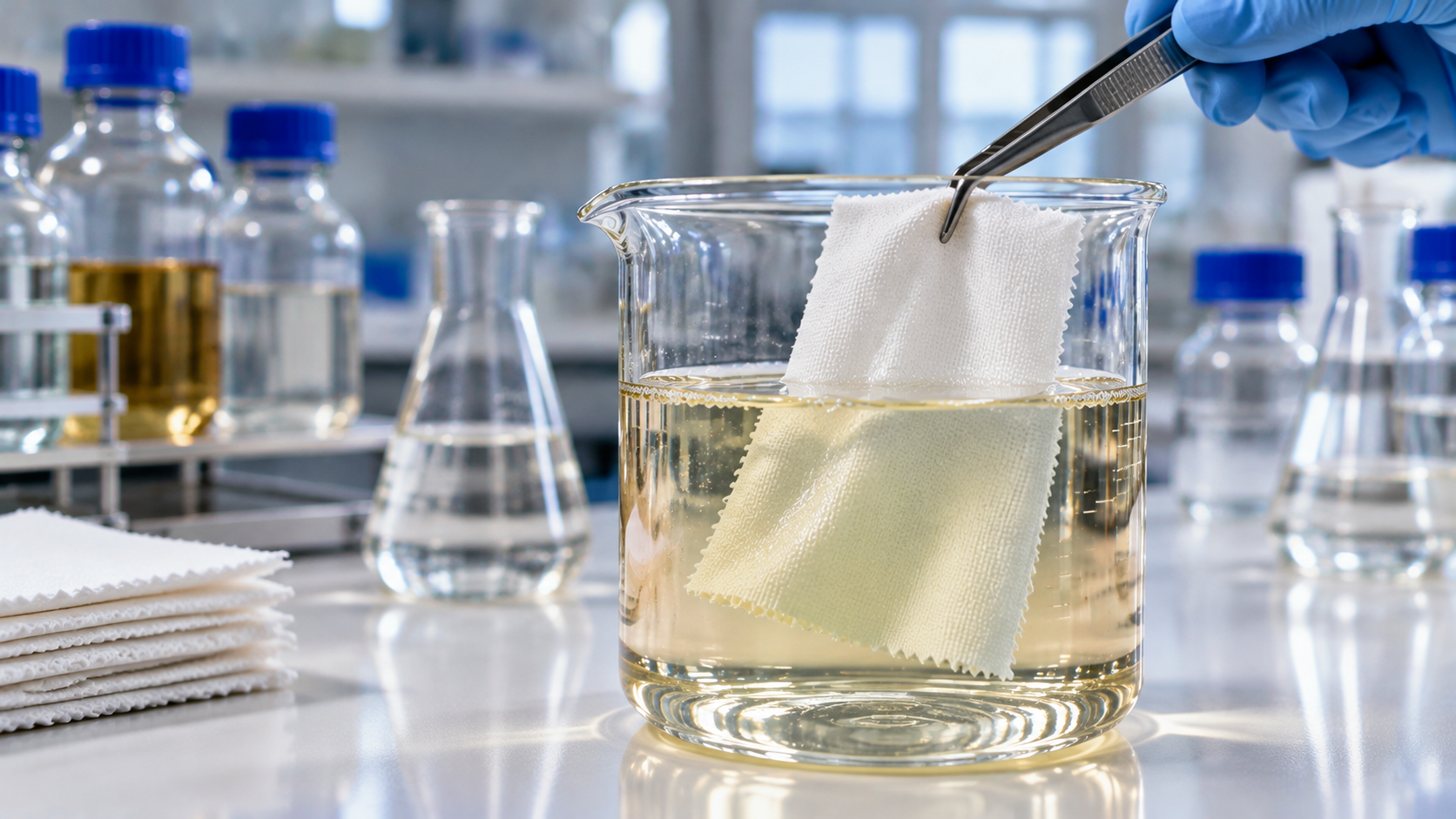
Laboratory evaluation showing rapid liquor penetration into the fabric structure.
Applications in Desizing, Scouring and Bleaching
The appropriate wetting agent depends on the process and the substrate being treated. Rapid Wetting Agent (Universal) is intended for several textile wet-processing applications.
- Desizing: Effective wetting helps the liquor penetrate sized yarns and contact residual sizing materials. The overall result also depends on the sizing system, desizing chemistry, temperature and treatment time.
- Scouring: The wetting agent supports contact between the alkaline liquor and the textile substrate, assisting the wider process of removing natural oils, waxes and other impurities.
- Bleaching: Uniform wetting helps distribute the treatment liquor across the fabric. For hydrogen peroxide bleaching, compatibility with the complete bleaching formulation should be confirmed.
- Other wet-processing applications: The product may be evaluated for selected additional applications where rapid wetting is required. Suitability should be established through testing rather than assumed from the term “Universal.”
The same product may perform differently across fabrics and process conditions. A formulation suitable for one production line should therefore be checked before it is adopted for other applications.
Why Purchase Price Is Not the Only Cost to Consider
When comparing textile pretreatment auxiliaries, the price per kilogram is only one part of the calculation. The amount required for each process, consistency of performance and compatibility with the existing formulation also affect the overall cost.
For example, a lower-priced wetting agent may not be the most economical choice if it requires a higher dosage or produces inconsistent results under the mill's operating conditions. Similarly, a product with a higher unit price may deserve consideration if it delivers the required performance at a suitable dosage.
The comparison should therefore focus on the cost of achieving the required pretreatment result, taking into account dosage, process consistency, potential reprocessing and compatibility with other chemicals.
A controlled trial helps establish whether a new product offers a practical advantage over the existing one. Rather than changing the production recipe based on price or a single laboratory result, mills can use comparative testing to make a more informed purchasing decision.
Frequently Asked Questions
What is the difference between a wetting agent and a textile penetrating agent?
The terms are often used for products that improve the contact between processing liquor and textile materials. A penetrating agent places particular emphasis on liquor penetration into the fabric or yarn structure. The actual functions depend on the product formulation.
Can an anionic wetting agent be used in high-alkali pretreatment?
Some anionic wetting agents are formulated for alkaline pretreatment. Suitability depends on the product's chemical stability and the actual bath conditions. Check the technical data and confirm performance through laboratory trials before production.
Can Rapid Wetting Agent (Universal) replace a scouring agent?
Not automatically. Its wetting, emulsifying and dispersing properties may assist pretreatment, but a dedicated scouring agent may still be required to achieve the specified cleaning performance.
How should the dosage be determined?
The starting dosage should follow the product's current technical data sheet. Final dosage depends on the fabric, water quality, bath composition and process requirements. Laboratory testing is recommended before bulk production.
Technical Support for Your Textile Pretreatment Process
Effective pretreatment depends on more than the choice of a single chemical. Wetting performance, alkali stability, compatibility and operating conditions all influence the final result.
We supplies textile pretreatment auxiliaries for industrial wet-processing applications, including Rapid Wetting Agent (Universal).
If your mill is experiencing slow wetting, inconsistent liquor penetration or compatibility problems in an alkaline bath, contact our team to discuss your process requirements.
We can provide product information and technical documentation to support your evaluation. You can also contact us to request a sample for laboratory testing or obtain a quotation.