How Chelating Dispersant 766 Helps Control Metal Ion Interference
A cotton fabric can come out of bleaching with uneven whiteness even when the temperature, peroxide dosage and processing time have not changed. In another production run, a dyehouse may notice fine deposits on the fabric or unexpected shade differences.
The first reaction is usually to check the chemical recipe. But the process water deserves just as much attention.
Calcium and magnesium are common hardness ions in industrial water. Iron and other trace metals can also enter the processing bath through incoming water, raw materials or equipment. Depending on the process conditions, these metal ions can interfere with bleaching, dyeing and washing.
This makes metal ion control an important consideration in textile wet processing, rather than something to address only after problems appear.
Chelating Dispersant 766 is a phosphate-free liquid auxiliary that combines metal ion chelation with impurity dispersion. It is designed for textile pretreatment, peroxide bleaching and reactive dyeing, with additional applications in post-dye washing.
Why Metal Ions Matter in Textile Processing
Hard water problems are not limited to visible scale inside a dyeing machine. They can affect the processing bath before any deposit becomes noticeable.
Calcium and Magnesium: Hardness and Precipitation
Calcium and magnesium are the main contributors to water hardness.
Depending on bath chemistry, they can react with auxiliary components or form poorly soluble compounds. Under alkaline conditions, calcium-containing deposits become especially troublesome.
In pretreatment, these deposits interfere with fabric cleanliness. During dyeing, precipitation can cause spots or uneven processing. The severity depends on water hardness, pH, temperature and the chemicals present. A water source that works well in one recipe can fail in another.
Iron and Copper: A Different Risk During Bleaching
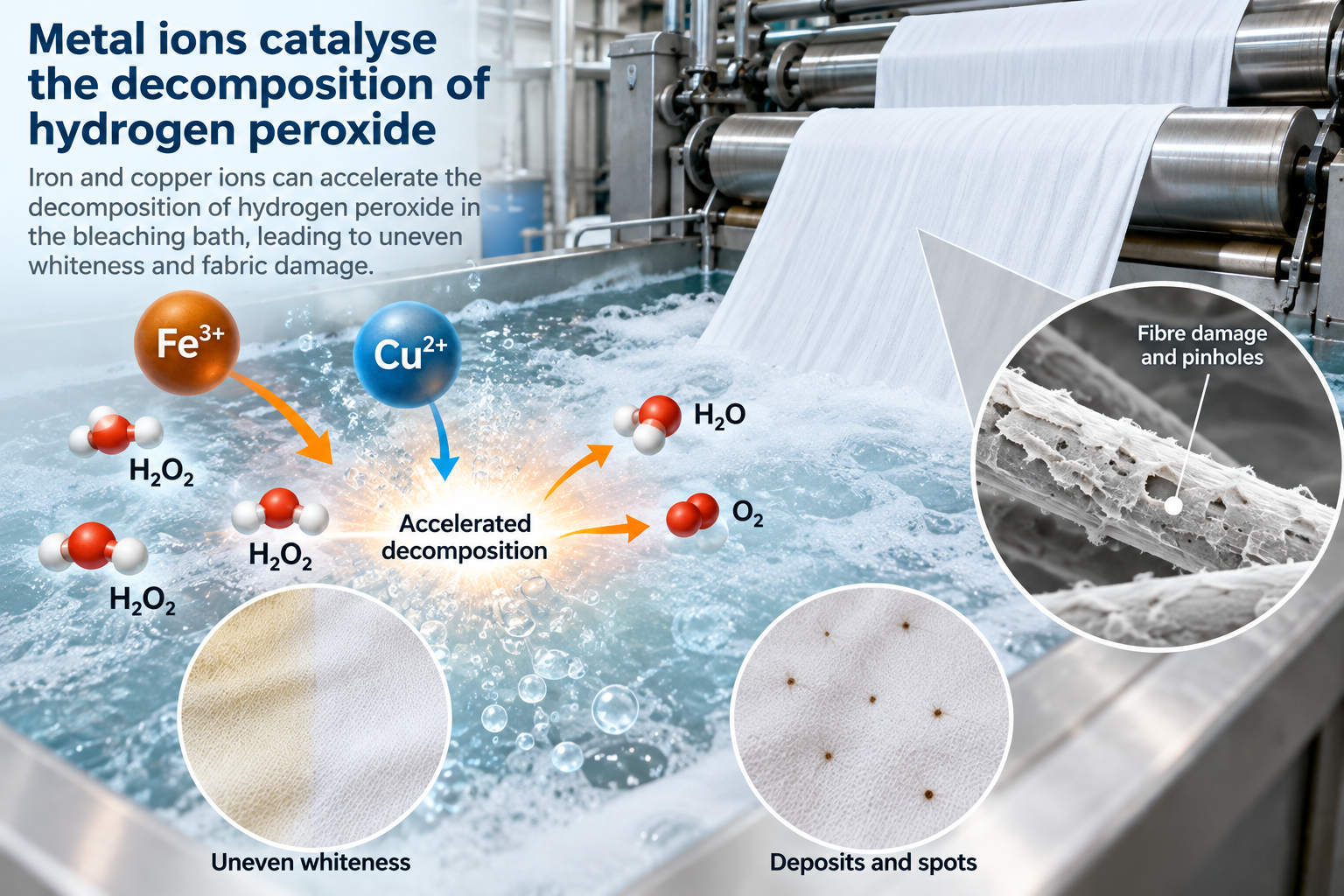
Iron and copper need particular attention during hydrogen peroxide bleaching.
These transition metals catalyse peroxide decomposition. When the reaction runs too fast, peroxide is consumed before it can do its job, and localised fibre damage can occur. In severe cases, this leads to pinholes and reduced fabric strength.
A peroxide stabiliser is normally used to keep bleaching under control. A suitable chelating agent provides additional support by reducing interference from dissolved metal contaminants. The two products serve different purposes and should not be treated as interchangeable.
Deposits in Processing Equipment
Hardness-related deposits also accumulate on equipment surfaces.
Calcium salts and certain silicate-related materials can contribute to fouling in pipes, tanks and other processing equipment. Controlling metal ions helps reduce some deposit-related problems. Heavy existing scale, however, usually requires a separate cleaning treatment.
What Makes Chelating Dispersant 766 Different?
Chelation controls dissolved metal ions such as calcium, magnesium and iron. By forming complexes with these ions, the chelating components reduce their tendency to interfere with other chemicals or form unwanted precipitation.
Dispersion addresses a different problem. During processing, impurities and particulate materials are released into the liquor. Dispersing components help keep these materials suspended instead of letting them aggregate or redeposit on the fabric.
Both functions can be useful in the same bath. A cotton scouring bath, for example, may contain dissolved hardness ions alongside impurities removed from the fibre. Controlling only one of these factors may not be enough for consistent processing.
Chelating performance depends on the actual metal ion concentration and processing conditions. The product should therefore be evaluated as part of the complete chemical formulation—not as a standalone fix.
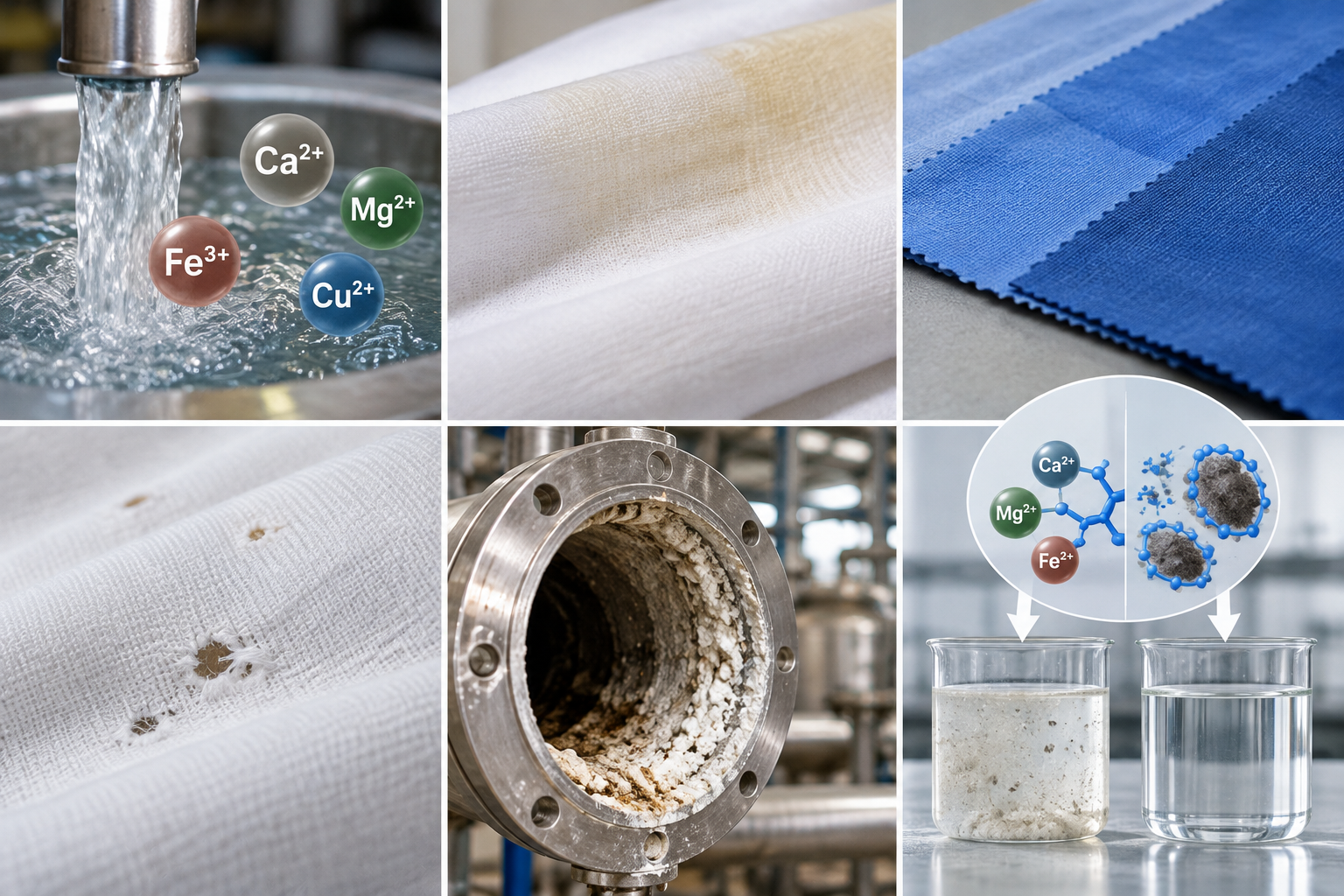
Figure: The impact of metal ions in textile processing — from fabric defects and equipment scaling to the chelation and dispersion mechanism of Chelating Dispersant 766.
Where to Use Chelating Dispersant 766
The correct dosage depends on your application.
Pretreatment (Desizing & Scouring): 1.0–2.0 g/L
Controls hardness ions while dispersing natural impurities. Evaluate alongside your scouring agent and alkali.
Hydrogen Peroxide Bleaching: 0.5–1.0 g/L
Use together with a peroxide stabiliser. The chelating agent controls metal ions; the stabiliser controls peroxide decomposition. Both are needed to prevent pinholes and uneven whiteness.
Reactive Dyeing: 0.2–0.5 g/L
Reduces metal ion interference and deposit-related problems. Confirm compatibility with dyes, electrolytes and alkalis.
Post-Dye Washing & Soaping: Trial required
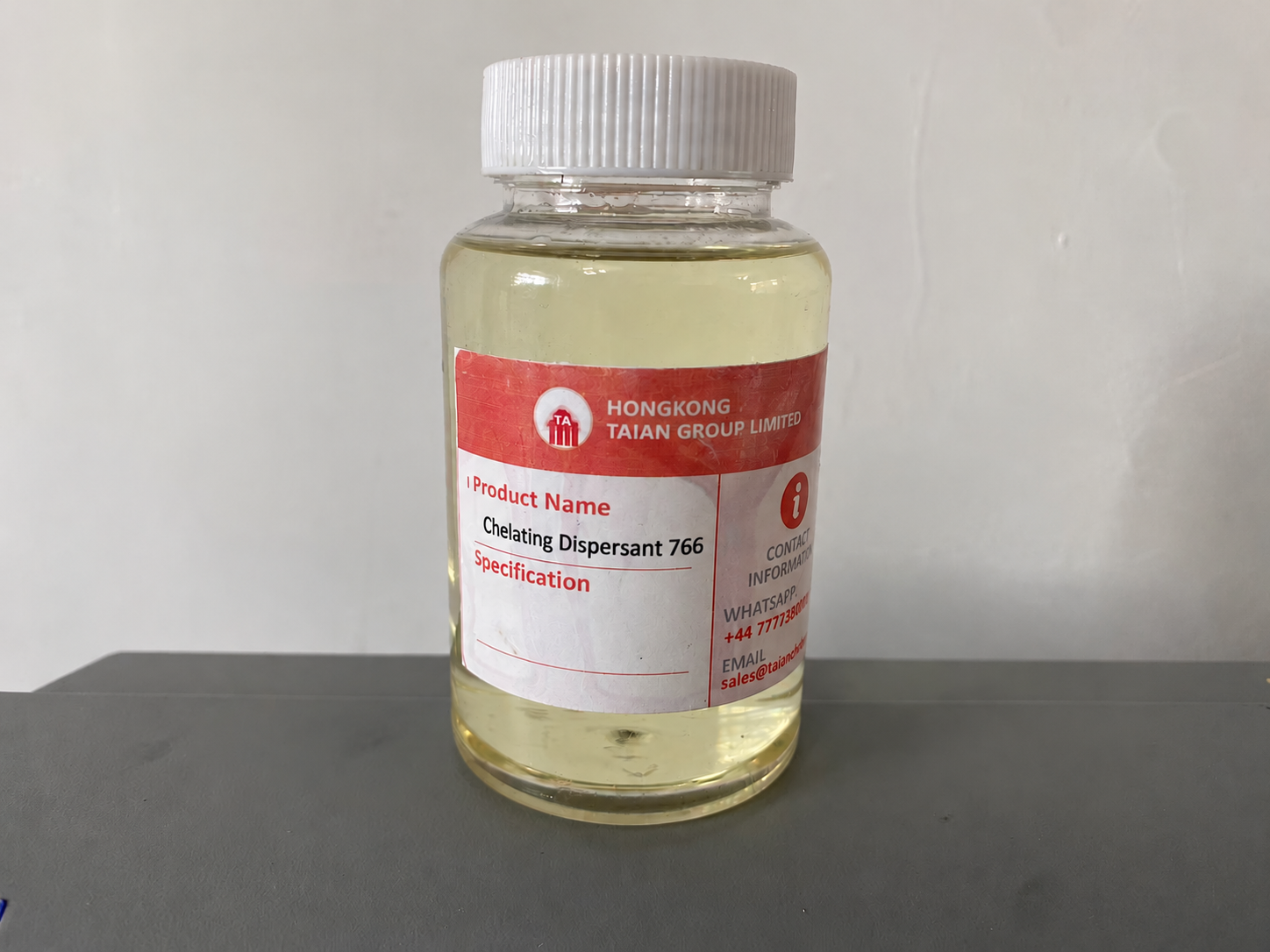
Figure: Chelating Dispersant 766 sample — a phosphate-free, cold-water soluble liquid auxiliary for metal ion control in textile wet processing.
How to Evaluate Performance Before Bulk Production
A chelating dispersant should not be selected only on its stated concentration or on a laboratory result obtained under unrelated conditions. Water quality and process formulation vary significantly between mills. A controlled comparison gives a more useful basis for deciding whether Chelating Dispersant 766 fits.
Start with the process water
Check total hardness and, where relevant, iron concentration. Take the water sample from the actual production supply point—not from a laboratory tap.
Compare under the same conditions
Prepare a control bath using the current chemical formulation and a trial bath using Chelating Dispersant 766. If you are replacing an existing product, compare technically appropriate dosages. Do not assume equal weight additions give equivalent performance.
Keep fabric, water, temperature, treatment time and other chemicals consistent wherever possible.
Measure results that matter to the process
| Application | What to measure |
| Pretreatment | Fabric cleanliness, wetting performance, visible deposits |
| Peroxide bleaching | Whiteness, peroxide residual, fabric strength |
| Reactive dyeing | Shade difference, levelness, visible deposits |
| Washing and soaping | Staining, colour fastness, cleanliness of washed fabric |
For reactive dyeing, visual assessment alone may miss small but commercially important colour variations. Instrumental colour measurement is useful.
Confirm on the production machine
Laboratory trials are necessary, but they cannot reproduce every condition found in bulk processing. Confirm the final addition level under the mill’s actual operating conditions
Avoid common trial mistakes
Treating a chelating dispersant as a drop-in peroxide stabiliser.
Increasing dosage without checking water hardness and iron levels.
Changing the chelating agent and scouring agent at the same time.
Comparing dyeing results under different liquor ratios, salt profiles or alkali conditions.
Judging performance only by appearance, without whiteness, strength or colour measurement.
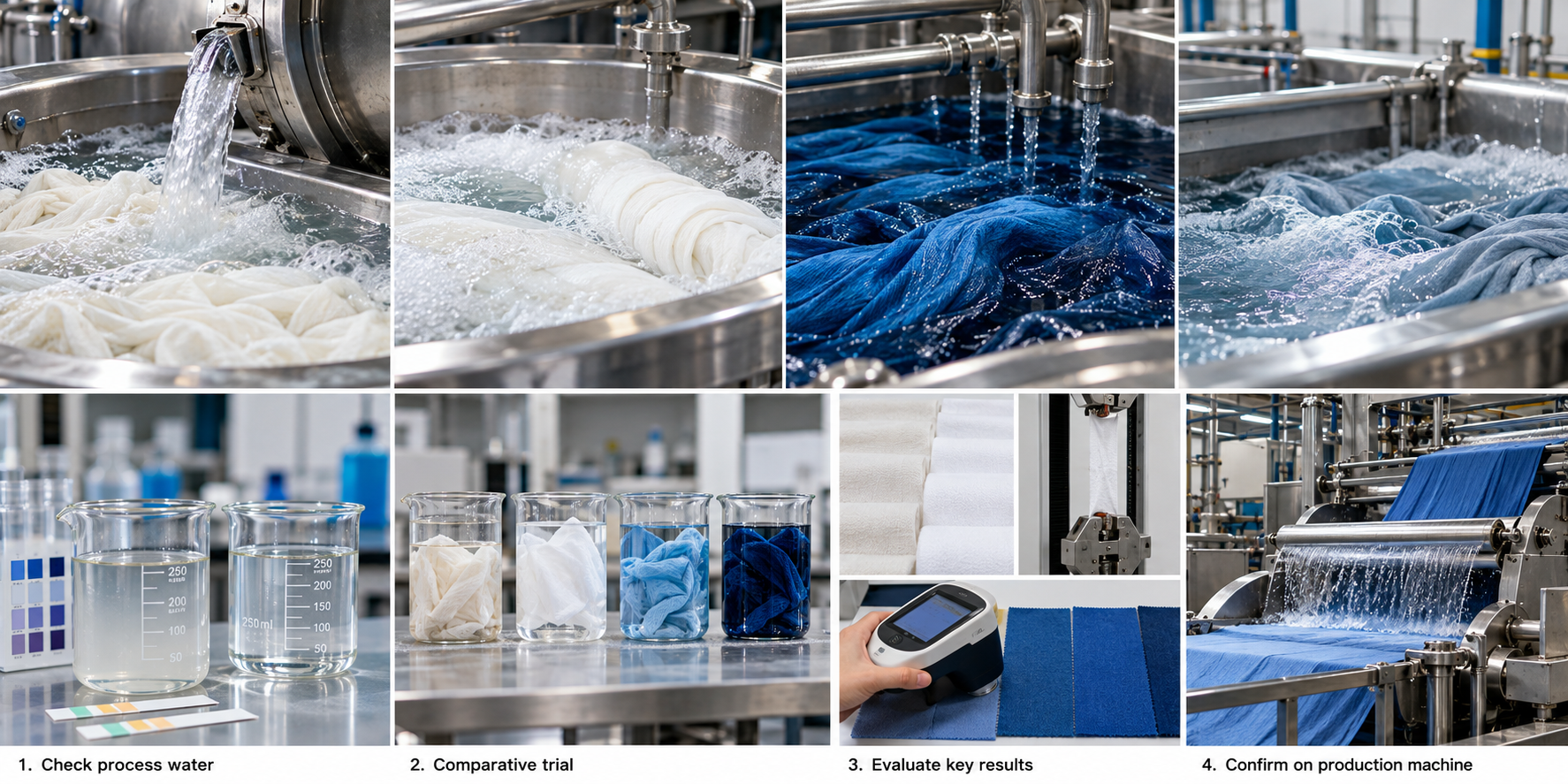
Figure: How to evaluate Chelating Dispersant 766 before bulk production — from checking actual process water to confirming the final dosage on the production machine.
Technical Specifications
| Parameter | Specification |
| Product name | Chelating Dispersant 766 |
| Appearance | Light-yellow transparent liquid |
| Odour | No unusual odour |
| pH | 6.0–7.0 |
| Content | ≥40% |
| Main components | Natural polysaccharide salts, multifunctional polymers and water |
| Solubility | Easily soluble in cold water |
| Formulation characteristic | Phosphate-free |
| Packaging | 200 g sample pack / 125 kg plastic drum |
| Shelf life | 12 months under recommended storage conditions |
Frequently Asked Questions
Can Chelating Dispersant 766 replace a peroxide stabiliser?
No. The product helps control metal ion interference and is recommended for use alongside a suitable peroxide stabiliser during bleaching. Test the complete formulation for compatibility and process stability.
Does higher dosage always improve performance?
Not necessarily. The required dosage depends on metal ion concentration, water quality and the overall formulation. Adding more than necessary can increase chemical cost without a proportional improvement. The best dosage is the one that meets process requirements under actual operating conditions.
Can it replace an existing chelating agent?
It may be evaluated as an alternative, but direct replacement should not be assumed. Different chelating agents vary in metal ion binding performance, concentration, stability and compatibility with other chemicals. Run a side-by-side trial before changing a production formulation.
Can it be used in post-dye washing?
Yes. The TDS identifies washing and soaping applications, particularly where impurity dispersion and reduced redeposition are required. It should not automatically be treated as a complete substitute for a dedicated soaping agent.
Is it suitable for phosphate-free formulations?
Yes. Chelating Dispersant 766 is phosphate-free. This can be useful for mills working toward more environmentally controlled chemical formulations. Confirm overall compliance with your local regulations and brand requirements.
Selecting a Chelating Dispersant for Your Dyehouse
When a dyehouse experiences uneven bleaching, deposits or inconsistent dyeing results, increasing chemical dosage is not always the right first response. Identifying the source of the problem is often more useful.
High water hardness calls for attention to calcium and magnesium. Rapid peroxide decomposition may indicate trace metal contamination, although peroxide stabilisation and operating conditions must also be checked. During washing, the redeposition of impurities may point to insufficient dispersing performance.
Chelating Dispersant 766 combines metal ion chelation with impurity dispersion for textile pretreatment, bleaching and dyeing applications. The appropriate dosage should be determined by the mill's water quality, process conditions and trial results.
Related Posts